








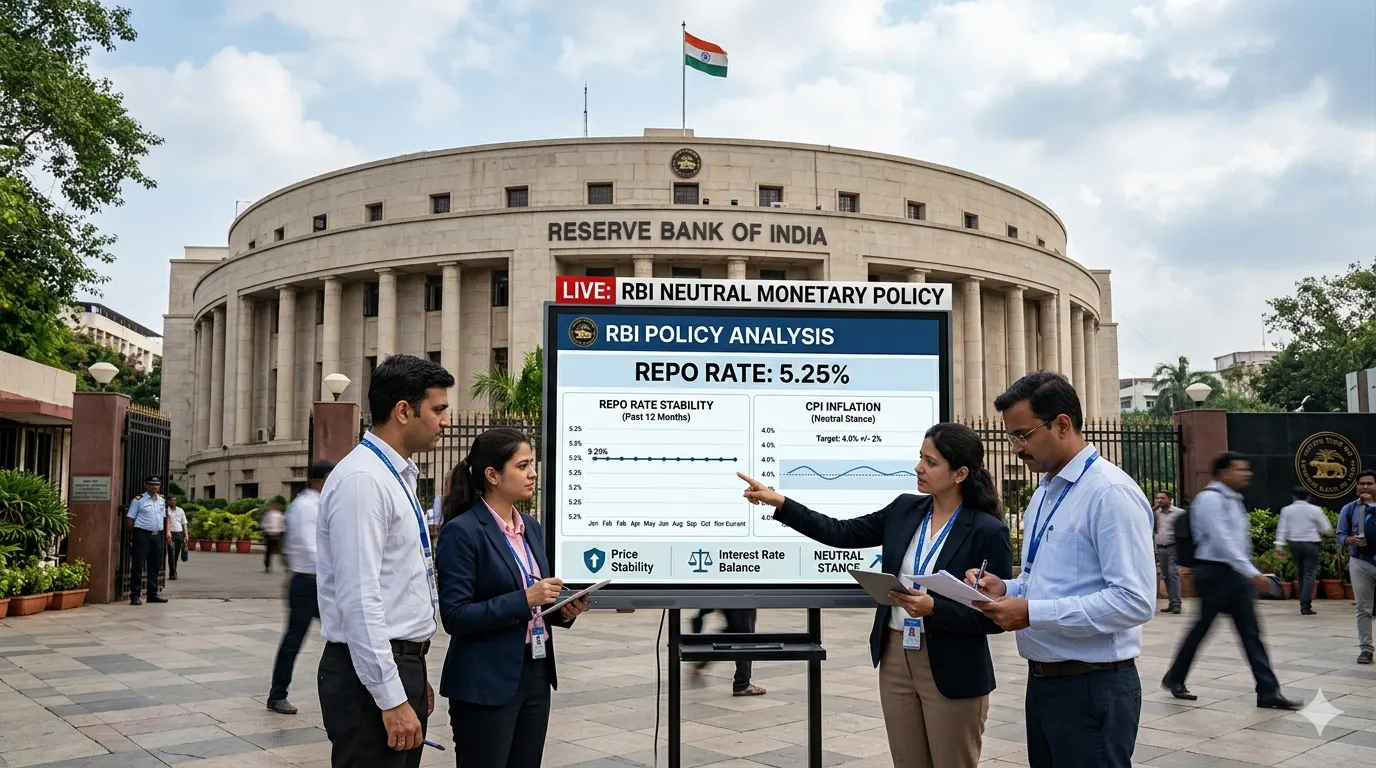
RBI maintains repo rate at 5.25% as policymakers assess inflation and growth balance.
Monetary Policy Committee (MPC) of the Reserve Bank of India has maintained the repo rate steady at 5.25% amid neutral policy stance as the committee gauges inflation dynamics and economic growth prospects.
The move reflects the caution of the central bank in its attempt to curb inflationary pressure without compromising on the economic growth.
What is the Repo Rate?
Repo rate is the interest rate charged by the Reserve Bank of India when lending money to commercial banks. Any change in the repo rate affects the interest rates on loans for consumers and businesses.
In case of no change in the repo rate:
- EMIs on loans do not fluctuate.
- Interest rates do not suddenly increase.
- Financial market conditions remain stable.
Reasons for Why the RBI Kept a Neutral Stance
Neutral means that the monetary authority does not feel the need to implement contractionary or expansionary policies.
According to economists, such a policy gives room for maneuvering according to:
- Inflationary dynamics
- Uncertainty in the world economy
- Growth dynamics in India
- Price dynamics of commodities
Maintaining policy stability often helps markets adjust gradually without sudden shocks.
Effect on EMI for Home Loans & Personal Loans
As no change was made in the repo rate, the interest rates on home loans, auto loans, and personal loans are unlikely to be affected immediately.
The banks generally revise their lending rates only when there is an evident change in the policy direction of the central bank.
It could be advantageous for potential borrowers and businesses that wish to invest in fixed assets.
Inflation Outlook is Critical
Inflation is one of the critical considerations that affect monetary policies.
The objective of central banks is to ensure price stability alongside maintaining adequate liquidity in the economy.
A sudden rise in the prices of food products, fuels, or international commodities may impact the decision-making process.
Market Reaction
In most cases, financial markets tend to be cautious in response to continuity in policies as it gives hints on potential interest rate changes.
Movements in bond markets, shares of banks, and foreign exchange may hint about economic expectations.
Conclusion
The decision by the Reserve Bank of India to maintain the repo rate at 5.25% shows balance amidst changing circumstances within the country and globally.
Individuals, companies, and other stakeholders will continue observing changes in the level of inflation as well as future directions provided by the Monetary Policy Committee.
Disclaimer
Prior to arriving at any conclusions based on this paper, readers are advised to take a thorough look at our Terms and Conditions available on our website. The analysis presented here is based on financial data and news available in public domains.