








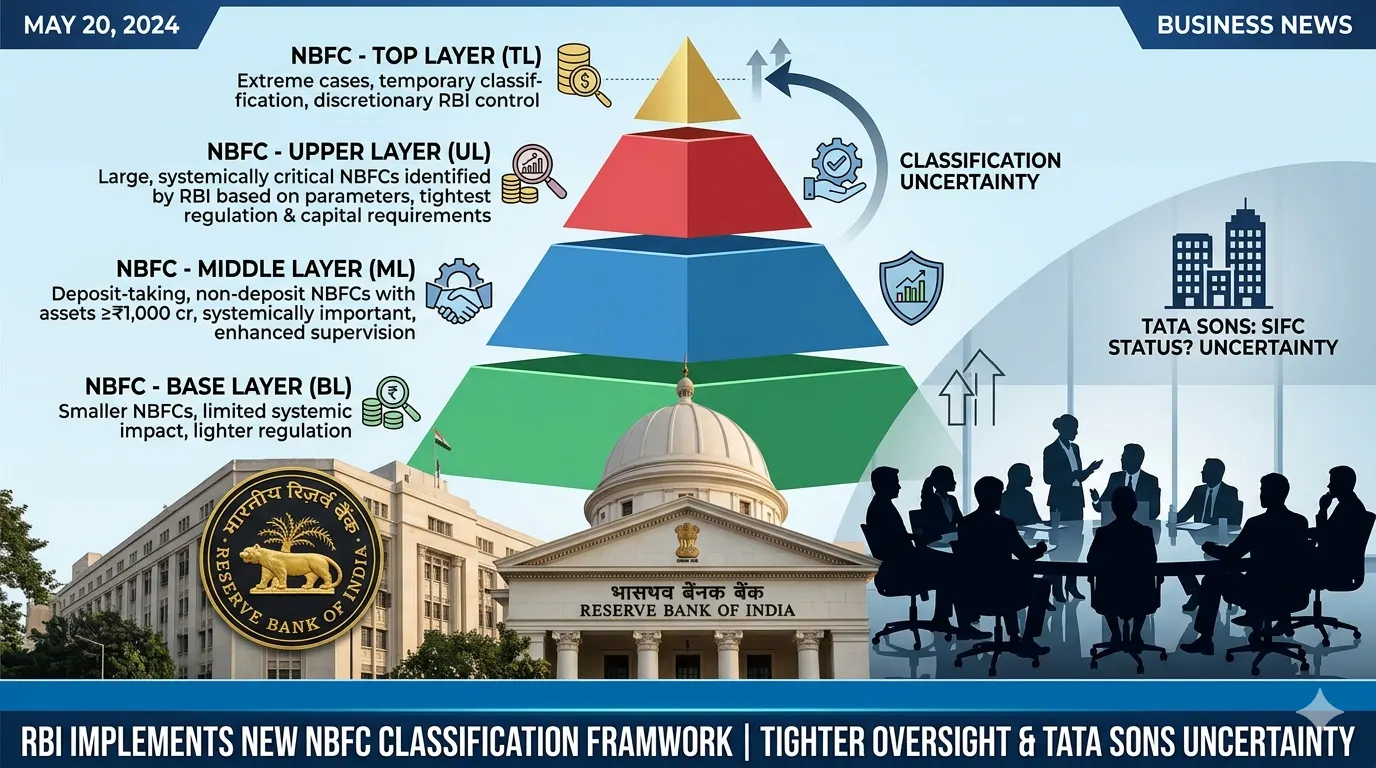
New RBI norms could reshape NBFC classification and oversight framework.
Proposed RBI Regulatory Measures for Government-Supported Non-Bank Financial Companies
The Reserve Bank of India plans to implement more stringent regulation of government-supported non-bank financial companies using stricter classification norms.
These measures will be implemented as part of the continuous process of maintaining financial stability and implementing regulatory norms consistently for all types of NBFCs.
Proposed Stricter Classification Norms for NBFCs
In India, there are several levels of classification of NBFCs, based on their size, riskiness, and significance.
These RBI measures include:
- Improved regulation of large and significant NBFCs
- Higher levels of transparency and risk monitoring
- Regulatory measures consistent with financial developments
These measures may lead to the reclassification of some institutions into other regulatory regimes.
Analysis of Government-NBFCs
It has been reported that there will be an overhaul in the classification process of government-owned or government-backed NBFCs as per the regulatory regime.
The main aim is to regulate the risk-exposure of all the NBFCs irrespective of their ownership structure.
There may be a change in the way such companies conduct their business.
Classification of Tata Sons
The recent news has led to the focus being placed on the classification of Tata Sons as an upper-layer NBFC as per the RBI rules.
There remains ambiguity about the future classification of the same entity after the new rules come into play.
Implications of Being an Upper-Layer NBFC
An upper-layer NBFC is viewed as a systemically important firm and therefore has to comply with more stringent regulations such as high capital and governance standards.
Such entities are closely scrutinized because of their importance to the stability of the financial system.
Change in status can result in a significant difference in compliance responsibilities.
Consequences on the Financial Industry
A tightening of regulations may:
- Boost stability in the financial system
- Enhance risk management
- Hike up compliance cost in NBFCs
- Boost confidence in the industry
In general, market players perceive stringent regulation as a positive move towards stability.
Conclusion
This framework that has been laid down by RBI will likely develop further through stakeholder consultation.
How classification norms will be developed and which companies will be included under such a framework will definitely be monitored keenly by both industry experts and investors.
This attempt by the RBI to regulate the NBFCs is indicative of its increasing concern for financial regulation within a fast-changing economic landscape.
The future development around the classification of Tata Sons will be one to look out for.
Disclaimer
It is important for all readers who will consider our analysis in order to make an independent judgment about our claims to read our Terms and Conditions page, which can be accessed through our website. This article was written using financial data and information obtained from reliable sources.