






Pakistan Strikes Afghanistan in what the government has termed an “open war” stance against the ruling Taliban regime, signifying a sharp rise in cross-border violence. The recent military operation has heightened tensions along the disputed border, sparking concerns of a larger-scale conflict with major geopolitical implications.
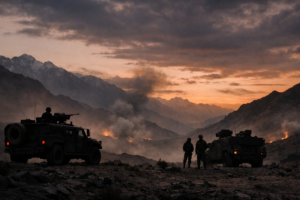
According to official reports and sources, the Pakistani military conducted targeted attacks within Afghan territory, justifying the move as necessary to eliminate militant groups operating from within Afghanistan. The Taliban-led administration in Afghanistan has strongly denounced the military strike as an infringement of sovereignty, threatening retaliatory attacks.
Why Did Pakistan Strike Afghanistan?
Tensions between Pakistan and Afghanistan have been brewing for months over security concerns, especially regarding the presence of Tehrik-i-Taliban Pakistan (TTP), a militant group that has been accused of conducting attacks within Pakistan.
There have been claims by Islamabad that militants have been using Afghan territory as a safe haven. However, the Taliban government in Kabul has rejected these claims, saying that it does not allow any group to use its territory to attack neighboring countries.
The latest attacks seem to be in retaliation for attacks that took place inside Pakistan’s border provinces. Military sources in Islamabad said that the attack was on “terror infrastructure,” while civilian casualties were reported in the areas affected, according to Afghan authorities, although this has not been confirmed by Pakistan.
Taliban Government’s Response
The Taliban regime, formally named the “Islamic Emirate of Afghanistan,” warned Pakistan about the attacks, labeling them an “act of aggression.” Taliban representatives stated that their military had taken defensive actions along the border in response to the attacks.
Since the Taliban recaptured Afghanistan in 2021 after the withdrawal of U.S. troops, the Taliban has attempted to gain international recognition while grappling with security within Afghanistan. A deterioration of relations with Pakistan, a long-time regional partner, would likely add to the Taliban’s political woes.
Regional and Global Implications
According to security analysts, an open military conflict between Pakistan and Afghanistan may destabilize the region of South Asia. This is because South Asia is already facing economic strain, the issue of refugees, and the problem of militancy.
The economic instability of Pakistan, together with the humanitarian crisis in Afghanistan, means that any open conflict between the two countries may further worsen the situation on both sides of the border. This is because the international community has called for restraint on the part of both countries.
What Happens Next?
Although both parties have engaged in strong rhetoric, the possibility of backchannel diplomacy being used in de-escalation efforts cannot be ruled out. In the past, tensions across the border between Pakistan and Afghanistan have escalated but eventually dissipated through negotiations.
However, the rhetoric of “open war” indicates that this is one of the most serious confrontations between the two countries in recent years. The next few days will be crucial in determining whether this is merely a limited military conflict or whether it escalates into a larger conflict.
Disclaimer
This article is based on information gathered from publicly available sources and regional media reports. Details may evolve as official statements and verified information emerge.


