
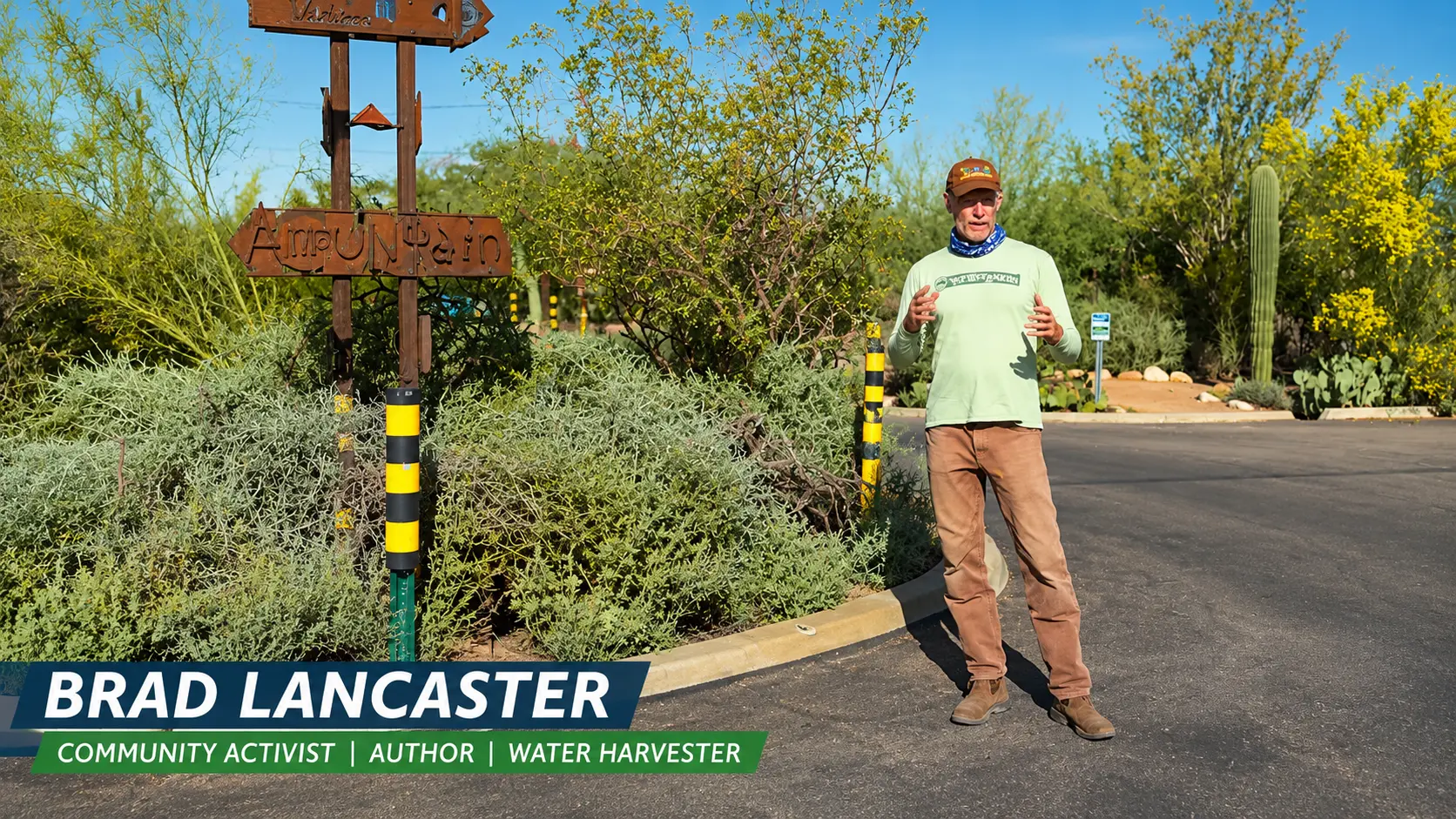
TUCSON, Arizona - On a quiet residential street in Tucson three decades ago, environmental advocate Brad Lancaster made a decision that challenged the way an entire city thought about water.
Armed with a hammer and basic tools, Lancaster cut an opening into the concrete curb outside his home, allowing stormwater flowing along the street to enter a shallow basin instead of disappearing into the city's drainage system.
At the time, the modification was considered unauthorized. Today, the same principle has become part of Tucson's approach to urban water management, with neighborhoods harvesting more than 1 million gallons (3.7 million liters) of stormwater annually in one community alone and influencing water conservation projects far beyond Arizona.
The transformation reflects a broader shift in how drought-prone cities are responding to climate change, rising temperatures and increasing pressure on water supplies.
A City Built to Move Water Away
Located in the Sonoran Desert, Tucson receives an average of about 11 inches (280 millimeters) of rainfall each year.
For much of the twentieth century, the city's drainage systems were designed with a single objective: move stormwater away from streets as quickly as possible to reduce flooding.
That engineering approach solved one problem but created another.
Rainwater that could have replenished soils and supported vegetation instead flowed into drainage channels and left the urban landscape within minutes of a storm.
At the same time, Tucson increasingly relied on imported water delivered through the Central Arizona Project, a canal system carrying Colorado River water more than 300 miles (480 kilometers) across the state. Moving that water requires significant pumping infrastructure and energy, making conservation an increasingly important priority as prolonged drought has reduced river flows.
For Lancaster, the contradiction was difficult to ignore.
"If the rain falls here," he has argued in public talks and publications, "why not use it here?"
That question would shape the next three decades of his work.
A Simple Idea That Grew Into a Community Project
Lancaster's approach was based on a straightforward principle: slow stormwater, allow it to soak into the ground and let plants use it naturally.
Instead of directing runoff into drains, volunteers began creating roadside basins, planting native vegetation and reshaping neighborhood landscapes to capture rainfall where it landed.
The changes were inexpensive compared with conventional infrastructure projects, relying largely on earthworks, native trees and community participation rather than concrete and underground pipes.
Over time, the effects became increasingly visible.
Trees that once struggled to survive in dry soil developed extensive canopies. Native shrubs and grasses replaced stretches of bare ground. Roadsides that previously contributed little to the urban environment became green corridors supporting birds, pollinating insects and wildlife.
According to Lancaster's documented case studies, the Dunbar/Spring neighborhood now harvests more than one million gallons of stormwater every year, water that would otherwise have entered drainage systems.
Community volunteers have also planted and maintained more than 1,700 food-producing and native trees, significantly expanding the area's urban canopy.
Thirty Years of Measurable Change
The physical transformation can be measured in numbers as well as appearance.
Three decades ago, rainfall was largely treated as runoff to be removed from city streets.
Today, stormwater is increasingly regarded as a local resource.
Lancaster's own property demonstrates what is possible on a household scale. On a residential lot of roughly one-eighth of an acre, his family harvests approximately 100,000 gallons (378,500 liters) of rainwater annually through a combination of rooftop collection systems and passive landscape design.
The water supports fruit trees, vegetable gardens and native vegetation without relying entirely on municipal irrigation.
The broader neighborhood has experienced similar benefits.
Expanded tree cover provides shade that can lower ground-level temperatures beneath mature canopies by more than 10°F (5.5°C) compared with nearby exposed surfaces during Arizona's hottest months.
Additional vegetation has also helped reduce erosion, improve soil health, increase biodiversity and slow stormwater flows during heavy rainfall events.
From Controversy to City Policy
Perhaps the most significant change has been institutional rather than environmental.
Practices that once attracted regulatory concern are now encouraged through municipal programmes.
Tucson has incorporated rainwater harvesting into urban planning initiatives and offers financial incentives to residents installing qualifying water-harvesting systems. Current rebate programmed provide homeowners with up to $2,000 for approved installations designed to reduce dependence on treated municipal water.
The policy shift reflects growing recognition that decentralized water management can complement traditional infrastructure rather than replace it.
Urban planners and environmental organizations from around the world have since studied Tucson's experience as cities search for practical responses to water scarcity and rising temperatures.
Lessons Beyond Arizona
The challenges facing Tucson are no longer unique.
According to the United Nations, billions of people experience water stress for at least part of each year, while climate change is increasing the frequency and severity of droughts across many regions.
Cities are investing billions of dollars in reservoirs, desalination plants and long-distance water transfers. Yet Tucson's experience suggests that relatively small interventions at neighborhood level can also play a meaningful role.
Capturing rainfall where it falls reduces pressure on drainage systems, improves groundwater recharge, supports urban vegetation and lowers demand for treated water.
For cities facing hotter summers and more variable rainfall, these measures can strengthen resilience while improving the quality of urban life.
A Different Way of Looking at Rain
Thirty years ago, Lancaster's curb cut was viewed by many as an unconventional act that challenged established engineering practice.
Today, similar techniques appear in municipal guidance, university research and climate adaptation strategies.
The rainfall arriving over Tucson has not changed significantly.
What has changed is how the city values it.
Rather than treating every storm as water to remove, growing parts of Tucson now see rainfall as a resource to capture, store and use locally.
That shift, from moving water away to keeping it where it falls, has helped reshape one neighborhood and offered a practical model for drought-prone cities around the world searching for sustainable ways to live with a changing climate.