
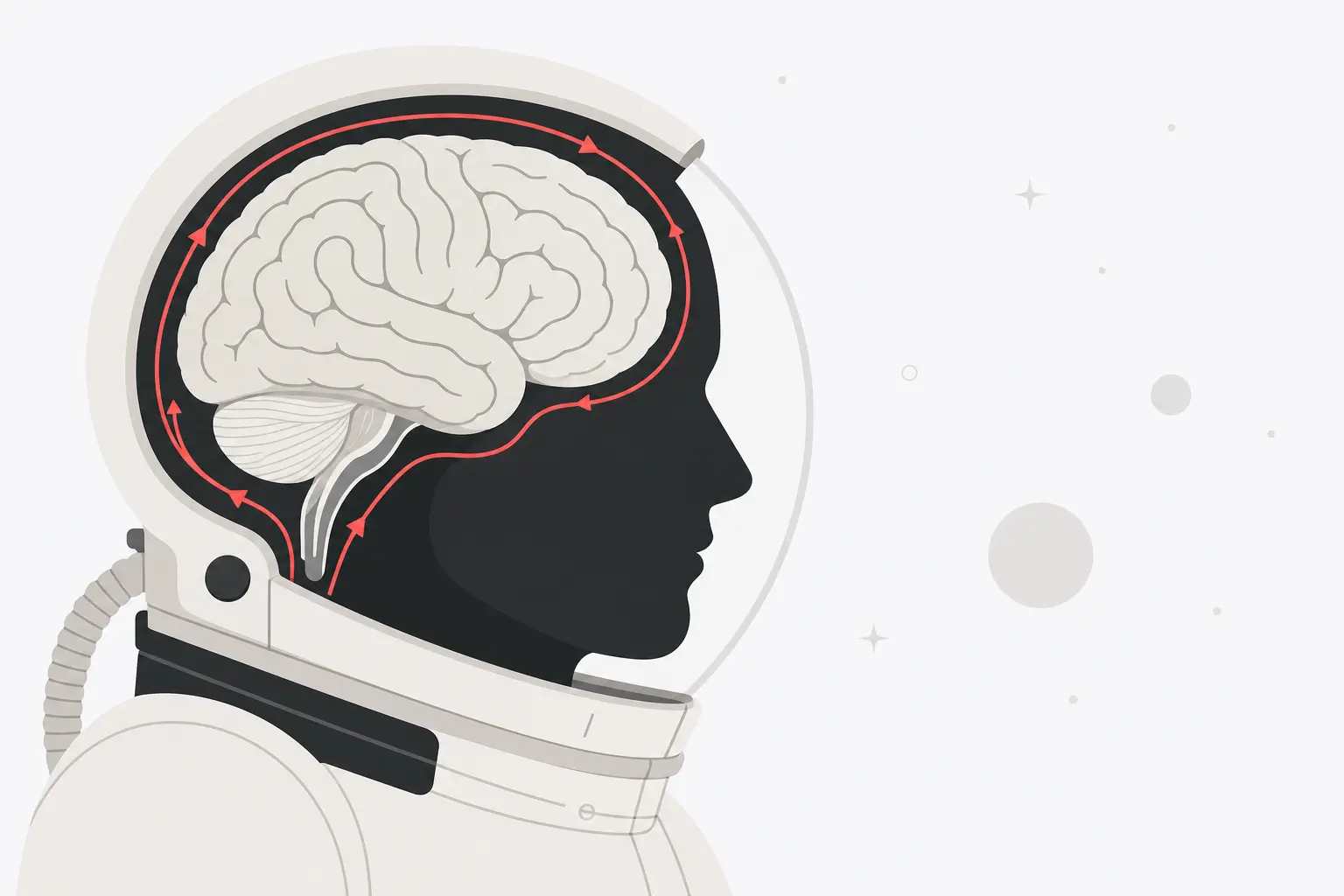
What happens to your brain in space?
Microgravity reshapes astronaut brains within weeks - causing fluid shifts, structural changes, and vision impairment that can persist long after return to Earth.
Microgravity reshapes the human brain within days. Cerebrospinal fluid, normally held partially in the lower body by gravity, floods upward toward the skull in space - raising intracranial pressure, triggering vision changes in up to 70% of long-duration astronauts, and producing measurable structural shifts in gray and white matter visible on MRI scans. Cognitive effects - slower processing, working memory strain, spatial disorientation - peak in the first two weeks and largely resolve by week three to four of a mission. Most changes reverse after landing, but some structural alterations persist beyond 12 months. For missions to Mars, which would last years, these findings represent an unresolved medical challenge.
The physics of the problem
HOUSTON - Gravity does more for the human brain than most people appreciate. On Earth, it acts as a continuous pump - pulling cerebrospinal fluid (CSF), the clear liquid that cushions and protects the brain and spinal cord, toward the lower body. Remove that gravitational gradient and the fluid has nowhere to drain.
In microgravity, CSF redistributes evenly throughout the cranial vault. The skull, a fixed bony container, cannot expand to accommodate the extra volume. The result: intracranial pressure rises. The effects radiate from there.
NASA's Human Research Program, which coordinates biomedical research on the International Space Station (ISS), has spent two decades tracking these changes across hundreds of astronauts. The picture that has emerged is one of a brain that adapts - but not without cost.
](https://cdn-public.eesel.ai/ed9a3b53-12e3-4f90-b319-af6da48bda02/6125b702-a809-47a8-97fe-dcd9f49ba278/3fec068eaada41d9becaaea7632da895.png)
Vision loss: the most documented risk
The most clinically significant brain-related consequence of spaceflight is Space-Associated Neuroocular Syndrome (SANS). It is not a fringe finding. Approximately 60 to 70% of astronauts on long-duration ISS missions develop measurable vision changes, according to NASA research data.
The mechanism is direct: elevated intracranial pressure from CSF redistribution presses on the optic nerves. The consequences include:
- Optic disc oedema - swelling at the point where the optic nerve meets the retina
- Refractive shifts - changes in the eye's focusing ability
- Cotton-wool spots - small white patches indicating nerve fibre layer damage
- Choroidal folds - structural deformations in the vascular layer behind the retina
- Blurred vision - affecting both near and distance vision
Vision changes typically emerge 2 to 4 weeks into a mission. One ISS astronaut described the experience during flight: "Around week 2 of the mission, my vision got blurry. I was worried at first, but my crewmate who had flown before told me it was normal and would improve. It did - by week 5, most of it had cleared up. Still some blurriness, but functional."
Recovery after landing is generally complete within 3 to 6 months, though some astronauts require longer. Research teams now use multi-modal imaging - retinal photography, optical coherence tomography, and MRI - to track changes in real time and identify which astronauts are at greatest risk before flight.
Structural rewiring: what MRI scans reveal
Beyond fluid dynamics, the brain's physical structure changes during spaceflight. A multi-centre study coordinating data from NASA, ESA, and Roscosmos astronauts found measurable gray matter volume changes in the majority of participants:
| Brain region | Observed change |
|---|---|
| Motor cortex | Volume increase - movement adaptation |
| Cerebellum | Structural remodelling - vestibular system |
| Hippocampus | Possible spatial memory reorganisation |
| White matter pathways | Fibre tract reorientation (DTI studies) |
The motor cortex expansion in 8 of 12 astronauts studied is consistent with the brain actively reorganising to control movement without the constant downward pull of gravity. Diffusion tensor imaging (DTI) studies have shown altered organisation in white matter pathways connecting motor and vestibular brain regions, with increased fractional anisotropy - a measure of how directionally organised neural fibres are - in sensorimotor pathways.
Crucially, structural changes did not correlate with cognitive deficits in most cases. The brain appears to compensate functionally even as its architecture shifts.
Follow-up imaging post-mission showed partial reversal of structural changes within 6 months. However, some astronauts retained altered brain structure 12 months after return to Earth - a finding with direct implications for planning very long-duration missions.
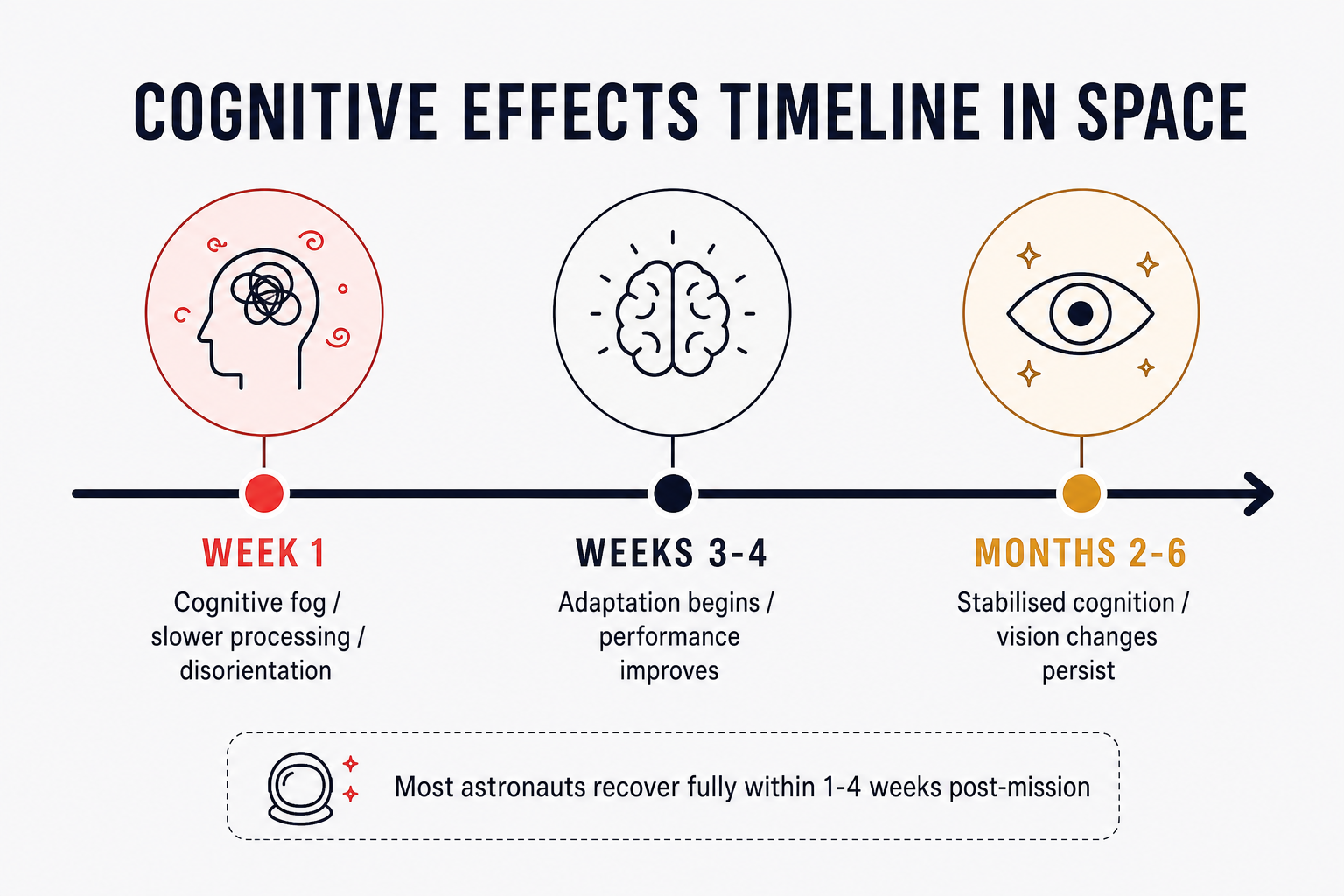
Cognitive effects: a predictable arc
Cognitive impairment in space follows a recognisable pattern. The first week is the hardest. Astronauts on recent ISS expeditions undergoing computerised cognitive testing showed:
- Working memory decrements of 15 to 25% in early spaceflight
- Reaction time slowing of 10 to 20%
- Higher error rates in repetitive procedural tasks
- Sustained attention variability depending on task structure
The causes are multiple: CSF pressure changes, vestibular system disorientation, disrupted sleep, and the cognitive load of operating in an unfamiliar high-stakes environment.
By weeks 3 and 4, most astronauts show marked improvement. The 2025 meta-analysis of data from more than 30 astronaut missions confirmed that working memory and processing speed impairments in weeks 1 and 2 were near-universal but resolved substantially for most participants by the fourth week.
"The first week was cognitively harder than I expected. By week three, I felt back to normal - maybe even more focused because there are fewer distractions."
- ISS expedition astronaut, post-mission debrief
The adaptation is not merely psychological. The brain's vestibular system, which processes orientation and balance, undergoes rapid neuroplastic reorganisation. By day 3 to 5, most astronauts have begun suppressing Earth-based assumptions about up and down. By weeks 2 to 3, movement through the ISS becomes automatic. Experienced astronauts report being able to mentally reorient within seconds when moving between modules.
](https://cdn-public.eesel.ai/ed9a3b53-12e3-4f90-b319-af6da48bda02/6125b702-a809-47a8-97fe-dcd9f49ba278/20ec28c48cf0462da9f8d8e4d233fe2f.png)
Sleep: the compounding variable
Disrupted sleep amplifies every other cognitive effect. Astronauts on ISS missions average 6.0 to 6.5 hours of sleep per 24-hour period - well below the recommended 7 to 8 hours, and below what most report needing. The ISS experiences 16 sunrises every 24 hours as it orbits Earth, continually disrupting the circadian system that regulates sleep onset.
Objective actigraphy and EEG data from recent missions show:
- Sleep latency of 20 to 30 minutes early in flight (versus a healthy average of under 10 minutes)
- REM sleep reduced by 10 to 20% in some astronauts
- Sleep efficiency of 70 to 80% - meaning astronauts spend a significant portion of time in bed awake
Melatonin supplementation is now standard practice for most long-duration ISS astronauts, improving sleep onset in some but not all individuals.
The neurological implications are direct. REM sleep is when the brain consolidates memories and processes information. Chronic REM reduction, sustained over months, compounds the working memory deficits of the early mission phase - and is one reason individual variation in cognitive performance in space is substantial. Astronauts who sleep better, adapt faster.
](https://cdn-public.eesel.ai/ed9a3b53-12e3-4f90-b319-af6da48bda02/6125b702-a809-47a8-97fe-dcd9f49ba278/fcee72c888aa447091efc1a5f768353e.webp)
Emerging research: biomarkers in blood and CSF
A newer frontier in space neuroscience involves measuring molecular changes in blood and cerebrospinal fluid samples. Studies from 2024 to 2026 have detected modest elevations in neuronal injury markers - including phosphorylated tau and neurofilament light chain - in astronaut samples taken during spaceflight.
These are the same biomarkers used to detect traumatic brain injury and early neurodegeneration in clinical medicine. Elevated levels in space do not necessarily indicate injury; they may reflect normal adaptive processes. Whether they represent a risk factor for long-term neurological consequences remains under active investigation.
The findings are preliminary, but they open a potential path to predicting which astronauts are at greatest risk before they fly - and to monitoring neurological status in real time during missions.
The Mars problem
NASA's Artemis programme is preparing to return humans to the Moon, and Mars missions - which would require 1 to 3 years of continuous spaceflight - are in long-term planning. The brain data collected from ISS missions, which typically run 6 months, shows that most effects are manageable at that duration. What happens over two or three years is unknown.
The 60 to 70% rate of vision impairment on 6-month missions alone warrants serious attention. Current countermeasure research includes:
- Lower-body negative pressure (LBNP) devices - pull fluid toward the lower body, reducing intracranial pressure; showed promise in some studies
- Postural protocols - regular head-down positioning to manage pressure
- Pharmaceutical interventions - acetazolamide and related compounds tested in limited studies
- Exercise protocols - physical exercise may reduce severity of vision changes but has not eliminated them
No single countermeasure has yet proven fully effective. NASA's Human Research Program identifies Space-Associated Neuroocular Syndrome as one of the five principal human risks of long-duration spaceflight - alongside radiation, isolation, hostile environments, and the physiological effects of gravity transitions.
The brain's adaptability is remarkable. What remains to be determined is whether that adaptability has limits over timescales longer than six months, and what the long-term consequences of pushing past them might be.
What to watch
NASA and international space agencies are expected to continue publishing longitudinal data from ISS missions throughout 2026 and 2027 as Expedition 73 and subsequent crews complete long-duration stays. Key questions being investigated include the viability of LBNP as a countermeasure for SANS, the significance of elevated neuronal biomarkers in blood samples, and the cognitive and neurological outcomes of astronauts who have completed multiple ISS rotations.
Separately, the commercial spaceflight sector - including SpaceX's Polaris Dawn programme and planned private station missions - will expand the pool of participants in spaceflight neurological research beyond the small, highly selected cohort of professional astronauts who have historically provided the data.
Vetopost independently produces this coverage based on publicly available information from official sources, including NASA's Human Research Program.