
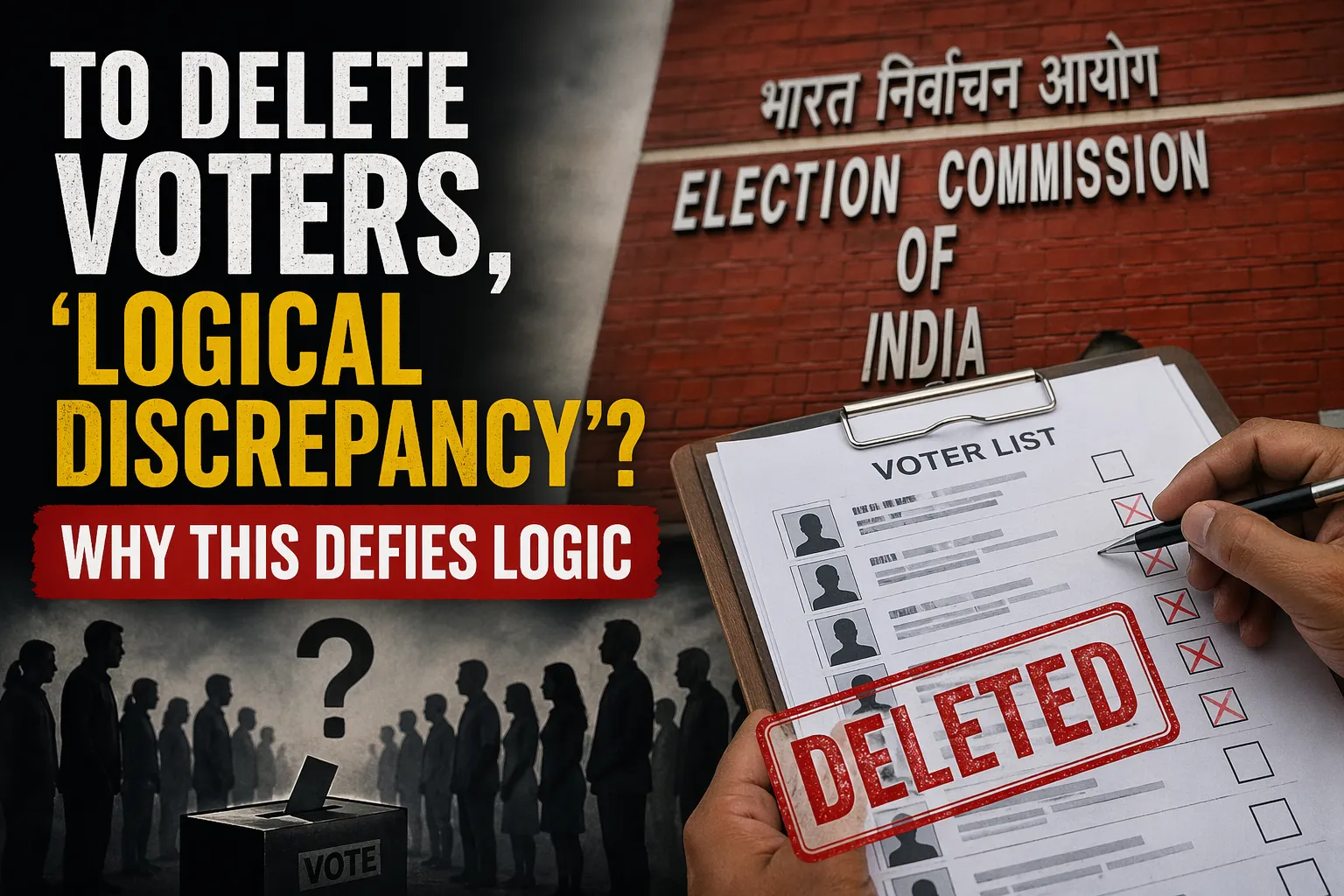






The Election Commission of India’s decision to delete certain names from the voters’ list under the guise of “logical discrepancy” has once again put its electoral practices under scrutiny. However, instead of providing clarity on the procedure, this explanation has made people more skeptical about the whole process and its intentions.
The real question that arises is whether a mere “discrepancy,” whose meaning is not clearly defined, can strip someone of his/her basic democratic right to vote.
What Does ‘Logical Discrepancy’ Even Mean?
“Logical discrepancy” is a phrase used by ECI to refer to any form of inconsistency found while verifying the voter list. In theory, the idea behind this measure was to have error-free and clean voter lists.
It is the fact that there is no definition given to this phrase and therefore no criteria for qualifying as logical discrepancies which is of concern. Such vagueness makes the use of this phrase potentially an easy way out to have someone’s name removed from the voter list.
For the voter, this means that it is when he goes to vote that he realizes his name has been deleted from the voter list because of a “logical discrepancy.”
Why Critics Say the Logic Doesn’t Add Up
Opposition leaders, civil society groups, and election watchdogs argue that the reasoning fails on multiple counts:
1. Absence of Transparency
If discrepancies are truly “logical,” they should be explainable. Yet, affected voters often receive no detailed reasoning behind their deletion.
2. Burden on the Voter
Instead of authorities proving why a name should be removed, the burden shifts to citizens to re-establish their eligibility—often through a lengthy and bureaucratic process.
3. Risk of Arbitrary Exclusion
With vague criteria, there’s a real risk that genuine voters—especially migrants, students, or economically vulnerable groups—could be disproportionately affected.
4. Timing Concerns
Voter list revisions close to elections raise suspicions, particularly if large numbers of deletions occur without adequate communication.
The Larger Democratic Concern
The electoral process in India, administered by the Election Commission of India, was always known for its strength. However, even a hint of an arbitrary removal of voters can harm people’s trust.
The right to vote is not only an administrative requirement but a constitutional one. In any case where a person is removed from the list of eligible voters, the process should be impeccable.
According to legal scholars, natural justice demands that:
People are properly informed,
Allowed to explain their situation,
And provided with a proper reason.
It is difficult for a poorly defined term like “logical discrepancy” to fulfill these requirements.
Conclusion
While maintaining accurate voter rolls is essential, the method matters just as much as the goal. A system that relies on ambiguous terminology risks excluding legitimate voters—and undermining the democratic process itself.
The debate over “logical discrepancy” is not just about semantics. It’s about whether the system protects the voter—or puts them at risk of being silently erased.
Disclaimer
This article is based on publicly available information, reports, and statements. It aims to provide a balanced overview of the issue without asserting definitive conclusions.