




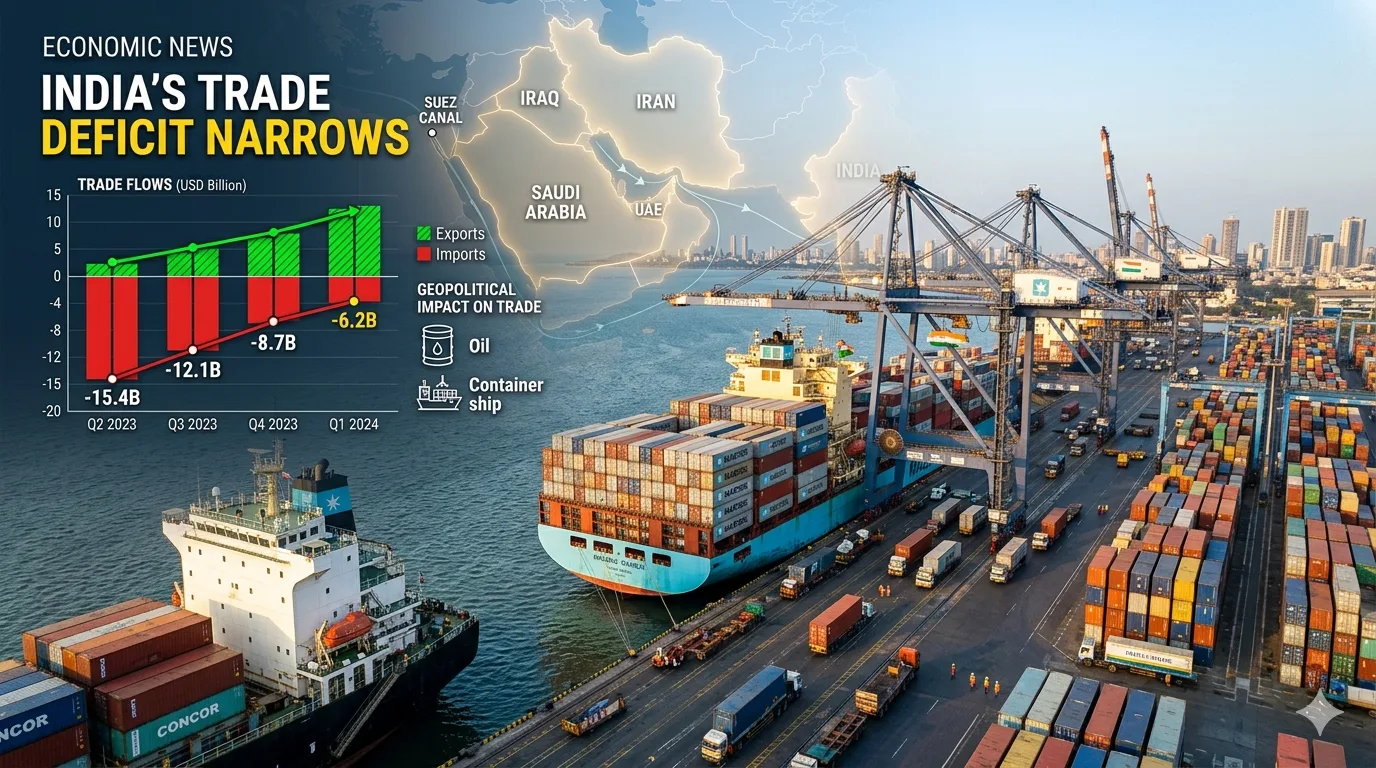
India’s trade balance improves slightly amid global uncertainty
India’s trade deficit declined to $20.67 billion in March, indicating an improvement in India’s external position amid continuing geopolitical unrest in West Asia that could affect international business dealings.
The trade deficit is an important measure that gauges the health of the economy and its external environment.
Exports Remain Unaffected
India’s exports have been stable in March amid uncertain economic conditions worldwide.
Unaffected exports have helped cushion the effect of rising import costs in energy and commodity prices.
Some factors that contribute to exports usually include:
- Engineering products
- Petroleum products
- Medicines
- IT-based services
Continuous exports are essential in balancing the trade deficit.
Pressures from Imports Persist
Imports remained high mainly because of reliance on crude oil and other crucial products.
Geopolitical tensions in West Asia pose risks for energy markets around the world, affecting the cost of imports.
An increase in import bills may lead to a higher trade deficit without an increase in exports.
Effects of West Asia Disputes
Events in West Asia pose threats to supply chains and fluctuations in energy prices.
Since India is one of the largest consumers of crude oil, India’s trade situation depends on energy market conditions around the world.
Economic Effects
A decrease in trade deficit might result in:
- Stabilization of the country’s currency
- Decreasing external risks
- Positive balance of payments prospects
- Economic growth promotion
But such improvement would require both an increase in exports and low cost of imports.
Prospects
The experts predict that in terms of trade development, everything will be determined by:
- World market conditions
- Commodity price levels
- Exchange rates changes
- Political situations
Uncertainty in global markets can affect future trade performance.
Conclusion
The decline in India’s trade deficit in March is seen as an optimistic sign despite uncertainties surrounding the world economy.
Nevertheless, geopolitical tensions and fluctuations in energy prices will continue to play a critical role in India’s future foreign trade environment.
Disclaimer
To derive any conclusion from this analysis, you are advised to visit the Terms and Conditions section on our website. This analysis is made using economic information sourced from reliable sources. The situation may differ as trade and economic conditions may vary over time.