








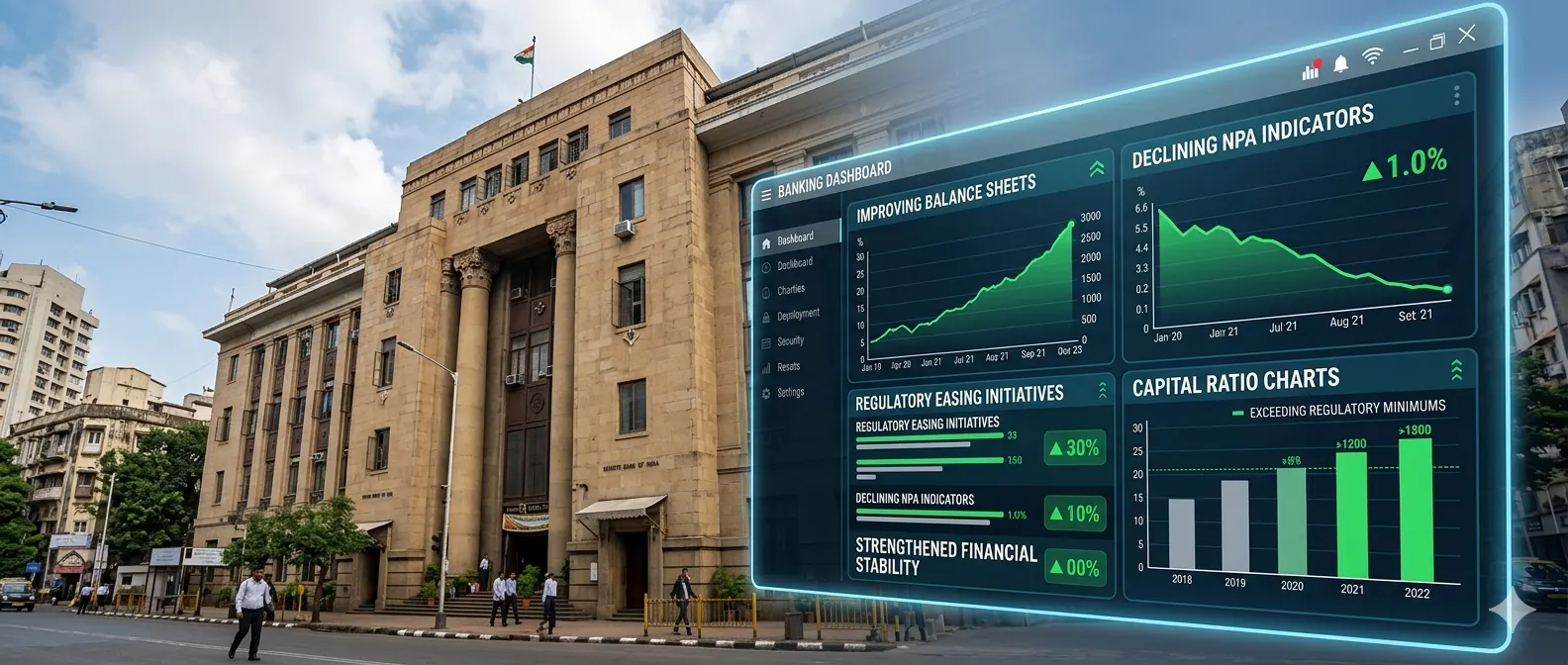
Regulatory relief expected to support bank balance sheets and lending capacity.
The Reserve Bank of India has relaxed capital regulations on non-performing assets (NPAs) and has also done away with the need for any additional Investment Fluctuation Reserve (IFR).
This will help enhance balance sheet efficiency while ensuring that financial institutions can allocate their capital more efficiently in an evolving economy.
What Are NPA-Linked Capital Regulations?
Banks are mandated to have adequate capital cushions in order to cushion themselves from possible losses emanating from non-performing loans.
Non-performing assets (NPAs) are those loans where the borrower defaults in making repayment within a given period.
NPA-linked capital regulations are intended to strengthen banks’ resilience in case of economic distress.
IFR Buffer Not Required Any Longer
Investment Fluctuations Reserve (IFR) serves as a buffer for volatility associated with fluctuations in bond prices and interest rates that affect banks’ investment activities.
Eliminating the IFR buffer requirement gives banks more flexibility in handling their investments and managing their capital structure.
The move is believed by analysts to result in better liquidity within the banking sector.
Implications for the Banking Sector
Some implications that arise from the easing of regulations include:
- Capital effectiveness
- Credit expansion
- Lending capacity enhancement
- Financial stability
It is common practice for banks to alter their credit strategy as regulations on capital change.
The improvement in flexibility may allow banks to aid the economy through credit expansion.
Reasons Behind RBI’s Decision
Most policy changes are made with the intent of balancing monetary stability and economic development.
At regular intervals, the RBI assesses and adjusts its regulatory policies based on economic changes, financial risks at the international level, and domestic credit needs.
In certain cases, changes in capital regulation could also be due to better asset management within banks.
Market Perspective
Bank stock prices occasionally rise following regulatory relaxation as increased capital flexibility could aid profit expectations.
Market participants pay close attention to central bank decisions in an effort to understand credit expansion patterns.
Conclusion
The move by the RBI to relax the guidelines for capital adequacy requirements concerning NPAs and abolish the need for IFR buffer is indicative of the RBI’s support for banks.
Financial institutions can be expected to gain benefits from the relaxed approach in capital management.
Disclaimer
While reading this report, it is important for you to remember that before making any decisions based on what you read here, please refer to our Terms and Conditions webpage on our website. This report has been written using publicly available financial information and news sources.