
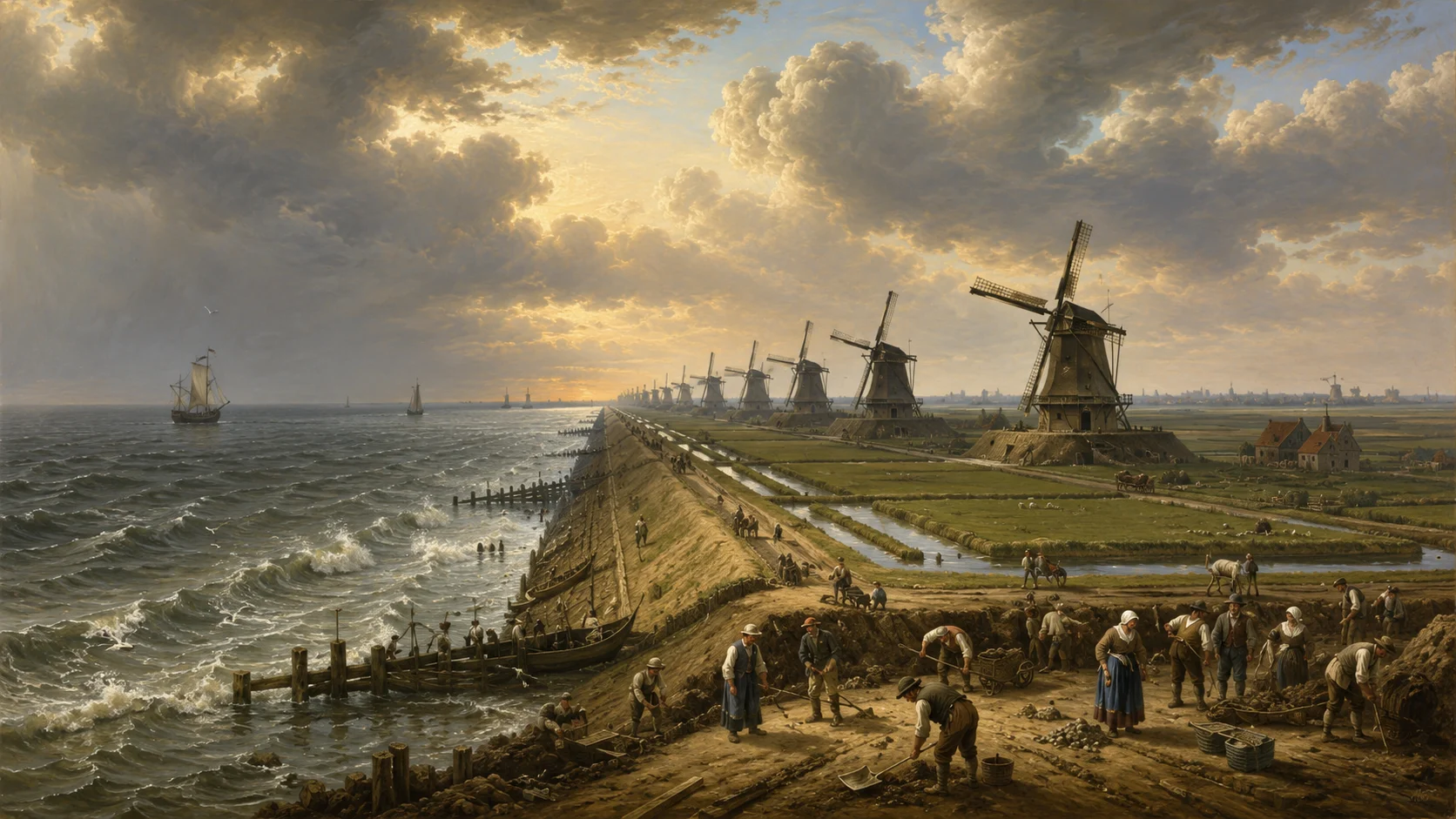
Part 2: The Day the Dutch Began Building Land from the Ocean
For centuries, the people of the Netherlands fought only to survive.
Every generation repaired broken dikes, rebuilt villages after devastating floods and accepted that the sea would occasionally reclaim what humans had worked so hard to build.
But sometime during the late Middle Ages, something remarkable happened.
The Dutch stopped asking how to keep the sea out.
Instead, they began asking a far more ambitious question.
Could they take land back from the sea itself?
It was an idea that sounded impossible.
Yet over the next 500 years, they would reclaim more than 7,000 square kilometres of land from lakes, marshes and the North Sea—an area larger than the Indian state of Goa. Entire towns, airports, highways and even a new province would rise where ships once sailed.
No civilization in history had attempted engineering on such a scale.
The Machine That Changed Everything
Ask someone about the Netherlands and they are likely to picture elegant windmills standing beside green fields under vast blue skies.
To tourists, they symbolize Dutch heritage.
To historians, they symbolize one of humanity's greatest technological breakthroughs.
Contrary to popular belief, Dutch windmills were never built simply to grind grain.
Many were built to move water.
By the fifteenth century, Dutch engineers had discovered that wind could power enormous scoop wheels capable of lifting water from low-lying land into canals. Later, these systems were upgraded with the Archimedes screw, a spiral mechanism that could move even greater volumes of water with remarkable efficiency.
The concept was revolutionary.
Instead of waiting for nature to decide where land ended and water began, people could now determine those boundaries themselves.
Lakes that had existed for centuries slowly disappeared.
Beneath them lay fertile soil waiting to be cultivated.
One of the earliest demonstrations of this ambition came in 1612, when engineers completed the drainage of Beemster Lake, north of Amsterdam.
Using a network of 43 windmills, they pumped millions of cubic metres of water into surrounding canals over several years.
When the final waters disappeared, more than 70 square kilometres of entirely new farmland emerged.
Today, the Beemster Polder is recognized as a UNESCO World Heritage Site, not because of its beauty alone, but because it marked the beginning of modern land reclamation.
It proved that humans could redesign geography.
Understanding a Polder
The Dutch word "polder" has no exact equivalent in many languages.
It describes land that was once underwater but has been enclosed by dikes and kept permanently dry through continuous water management.
Creating a polder was never as simple as building a wall.
First, engineers constructed a ring of dikes around the chosen area.
Then came canals, carefully designed to collect water from every corner of the reclaimed land.
Windmills continuously pumped that water into higher canals, which eventually emptied into rivers or the sea.
The work did not stop once the land appeared.
It never stops.
Rain continues to fall.
Groundwater continues to rise.
Rivers continue to swell.
Without constant pumping, many polders would slowly flood again.
Even today, thousands of electric pumping stations operate across the Netherlands every hour of every day.
The country's existence depends not only on engineering, but on relentless maintenance.
Amsterdam: A City Built on Water
Few visitors realise that Amsterdam, one of Europe's most visited capitals, owes its existence to this battle against water.
Much of the city stands only a few metres above sea level.
In some districts, the ground lies below it.
The city's famous canals were not originally designed for sightseeing.
They were part of an advanced water management system that regulated water levels, transported goods and protected surrounding neighbourhoods.
Because the soft soil could not support heavy buildings, engineers drove millions of wooden piles deep into the ground until they reached stable sand layers below.
Even today, many of Amsterdam's historic buildings remain supported by timber foundations installed hundreds of years ago.
The Royal Palace on Dam Square alone rests on approximately 13,659 wooden piles.
Every elegant canal house tells a hidden engineering story.
A Growing Nation With Limited Land
By the nineteenth century, the Netherlands faced a new challenge.
Its population was growing rapidly.
Agriculture required more land.
Cities needed room to expand.
Industry demanded ports, railways and factories.
But unlike larger nations, the Dutch could not simply move farther inland.
There was almost no inland left.
The sea remained their only option.
The question was no longer whether they possessed the technical knowledge.
It was whether they possessed the courage.
The answer arrived in the form of one visionary engineer.
Cornelis Lely's Impossible Dream
In 1891, Dutch engineer Cornelis Lely presented an idea so ambitious that many considered it unrealistic.
He proposed closing off the vast Zuiderzee, a dangerous inlet of the North Sea that regularly flooded nearby communities.
Instead of allowing tides to enter, Lely envisioned constructing a giant barrier across the sea.
Once enclosed, saltwater could gradually become freshwater.
Large sections could then be drained and converted into farmland.
The proposal stretched engineering beyond anything attempted before.
The barrier alone would extend more than 32 kilometres.
It would face powerful North Sea storms year after year.
For decades, politicians debated whether such a project was even possible.
Then disaster struck.
When Floods Accelerated History
In 1916, severe storms pushed seawater deep into the Zuiderzee.
Thousands of hectares of farmland disappeared beneath saltwater.
Homes were destroyed.
Livestock drowned.
The flood did not kill as many people as earlier disasters, but it changed public opinion.
What had once seemed an expensive dream suddenly became a national necessity.
Two years later, in 1918, the Dutch Parliament approved one of the largest civil engineering projects in history.
Construction began in 1927.
Five years later, after placing millions of tonnes of sand, clay and stone into the sea, workers completed the Afsluitdijk.
The massive barrier stretched 32 kilometres, standing roughly 7.25 metres above sea level.
For the first time in history, the Zuiderzee was separated from the North Sea.
Saltwater slowly transformed into a freshwater lake known today as the IJsselmeer, one of Europe's largest freshwater reservoirs.
The project fundamentally changed the geography of the Netherlands.
Yet the Afsluitdijk was only the beginning.
The Dutch had not built the dam merely to stop floods.
They had built it to create entirely new land.
Creating a New Province
Over the following decades, engineers drained one section after another behind the new barrier.
As pumps removed billions of litres of water, fertile seabed emerged.
The first reclaimed region, the Wieringermeer Polder, appeared in 1930.
Others followed.
The Noordoostpolder emerged during the 1940s.
Eastern Flevoland followed in the 1950s.
Southern Flevoland arrived in the 1960s.
Together, these projects created an entirely new province known as Flevoland.
Covering approximately 1,412 square kilometres of land, Flevoland became the youngest province in the Netherlands, officially established in 1986.
Today, more than 440,000 people live in a province that did not exist a century ago.
Its capital, Lelystad, is named after Cornelis Lely—the engineer whose vision transformed open water into thriving communities.
Modern highways cross land where fishing boats once sailed.
Airports, schools, farms and businesses operate on ground that spent centuries beneath the sea.
Perhaps nowhere else on Earth demonstrates humanity's ability to reshape nature more dramatically.
By the middle of the twentieth century, the Dutch believed they had finally mastered the sea.
Then, on a cold winter night in 1953, nature delivered a devastating reminder that the battle was far from over.
A single storm would kill nearly 1,836 people, inundate 200,000 hectares of land and forever change the future of Dutch engineering.
It would lead to one of the greatest flood protection systems ever built—the Delta Works.
To be continued in Part 3: "The Night the Sea Came Back – The 1953 Flood That Changed the Netherlands Forever."