
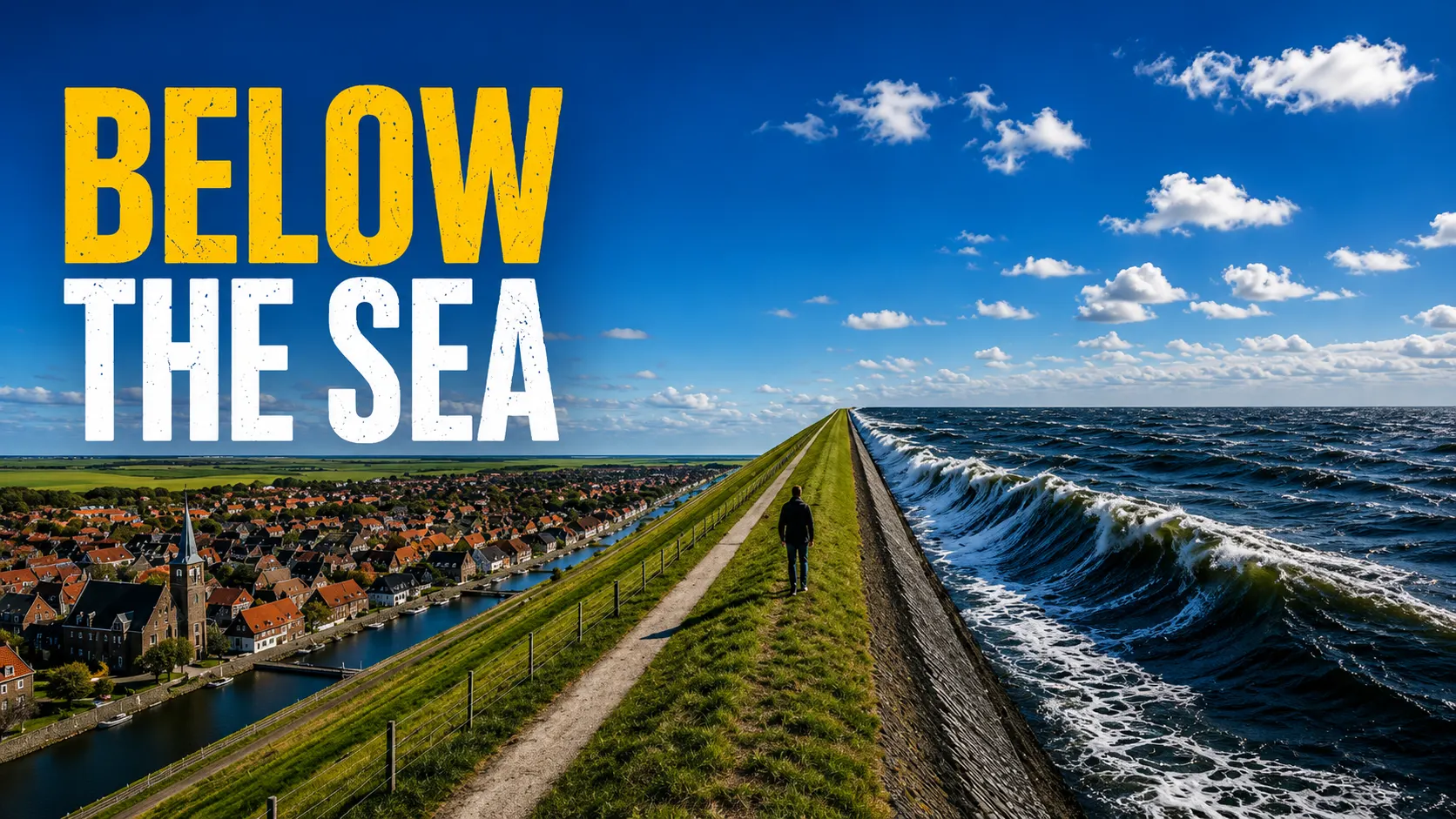
Part 1: A Nation Built Where the Ocean Once Ruled
By Vetopost Weekend
On a calm spring morning, visitors standing atop the Afsluitdijk, a 32-kilometre-long dam stretching across the northern Netherlands, often struggle to believe what lies beneath their feet.
To one side, freshwater stretches toward the horizon like an inland sea. On the other, waves from the North Sea crash against one of the world's most remarkable engineering structures. It is a landscape that appears ordinary until one learns an astonishing truth.
Much of the country standing behind those dikes should not exist.
Around 26% of the Netherlands lies below mean sea level, while another 29% sits less than one metre above it. In total, nearly 59% of the country's land is vulnerable to flooding from the sea, rivers or heavy rainfall. More than 10 million people - over half of the Dutch population of nearly 18 million live in these low-lying areas, protected not by mountains or natural barriers, but by an intricate network of dikes, canals, pumping stations and floodgates built over centuries.
For most nations, geography is destiny.
For the Dutch, geography became a challenge they refused to accept.
The Netherlands is often celebrated for its tulip fields, windmills and cycling culture, but beneath those postcard images lies one of humanity's greatest engineering achievements. Every day, millions of Dutch citizens wake up, go to work and raise families on land that the sea would reclaim within days—or even hours in some places—if the country's water management systems stopped working.
It is a nation built not simply on land, but on determination.
Where Land Meets the Sea
To understand why the Netherlands exists at all, one must first travel back thousands of years, long before modern cities, highways and ports transformed the landscape.
The country occupies the delta where three major European rivers the Rhine, the Meuse and the Scheldt meet the North Sea. For centuries, these rivers carried enormous quantities of sand and sediment from the Alps and central Europe, depositing them along the coast.
Rather than forming solid ground, they created an unstable landscape of marshes, peat bogs, tidal flats and shallow lakes.
Twice each day, tides pushed seawater inland.
During winter storms, powerful winds drove the North Sea over the fragile coastline, flooding villages and farmland. Rivers added to the danger by overflowing after heavy rainfall or snowmelt upstream.
The result was one of Europe's most unpredictable landscapes.
Roman historian Pliny the Elder, writing in the first century AD, described the inhabitants of the region living on raised mounds surrounded by water, waiting for tides to rise and fall. To outsiders, the settlements appeared temporary, almost as though they floated between land and sea.
Yet the people stayed.
Instead of abandoning the coast, successive generations chose something far more difficult.
They decided to change it.
Living With Water Before Fighting It
The earliest Dutch settlers understood they could not defeat nature with the limited technology available to them.
Instead, they adapted.
Around 500 BC, communities began constructing terpen artificial earthen hills built several metres above flood level. Entire villages, farms and churches stood atop these man-made mounds, allowing people to survive seasonal floods while the surrounding countryside disappeared beneath water.
Thousands of terpen were built across the northern Netherlands over the following centuries.
The strategy worked.
But it had limits.
As populations grew, agriculture became increasingly important. Livestock required grazing land. Crops demanded fertile fields. Living on isolated hills surrounded by water could support small communities, but it could not sustain a growing society.
People needed more land.
The only place to find it was beneath the water itself.
The Birth of the Dike
By the 10th century, Dutch communities began constructing something that would forever change their relationship with the sea.
The first dikes.
Unlike the towering concrete flood barriers seen today, these early structures were little more than earth embankments reinforced with clay, reeds and timber. Built by hand using simple tools, they followed rivers and coastlines, holding back floodwaters long enough for farming to become possible.
Each village initially built its own defences.
That approach quickly revealed a harsh reality.
A weak dike in one community could flood every settlement behind it.
Water, after all, respects no political boundaries.
The survival of one village depended on the efforts of its neighbours.
Centuries before modern governments developed national flood policies, Dutch communities were forced to cooperate.
Out of necessity emerged one of Europe's earliest forms of regional governance.
Local organisations known as water boards, or waterschappen, were established to maintain dikes, manage canals and coordinate flood protection. Historians consider many of these institutions among the oldest continuously functioning democratic organisations in the world.
Some date back to the 13th century and still operate today.
Every landowner contributed labour, materials or taxes.
Ignoring maintenance was not merely irresponsible.
It endangered everyone.
The sea had created a society where cooperation became essential for survival.
When Success Created a New Threat
As the Dutch expanded their dike networks, they reclaimed increasing amounts of marshland for farming.
Fields replaced wetlands.
Villages grew into towns.
Trade flourished.
But an unexpected problem soon emerged.
Much of western Netherlands sat on peat, an organic soil formed over thousands of years from partially decomposed vegetation.
When drained for agriculture, peat begins to dry out.
As it dries, it shrinks.
As it shrinks, the ground sinks.
In many areas, the land subsided by several centimetres every decade.
What had once been safely above sea level gradually slipped below it.
The very act of reclaiming land made future flooding even more dangerous.
The Dutch found themselves trapped in an extraordinary cycle.
Every improvement required another.
Higher dikes led to more farming.
More farming caused greater land subsidence.
Lower land demanded even higher dikes.
Generation after generation inherited not only land, but the responsibility to defend it.
The battle against water was becoming permanent.
Storms That Changed History
Nature repeatedly reminded the Dutch that victory was never guaranteed.
One of the most devastating disasters occurred in 1287, when the St. Lucia's Flood struck the northern coast.
Powerful storm surges overwhelmed fragile dikes, killing an estimated 50,000 to 80,000 people, making it one of Europe's deadliest floods.
Entire villages disappeared beneath the sea.
The coastline was permanently reshaped.
A vast inland bay known as the Zuiderzee expanded dramatically, swallowing farmland that had fed generations.
For many countries, such destruction might have prompted retreat.
The Dutch responded differently.
They rebuilt.
They strengthened their dikes.
They studied the failures.
Each catastrophe became another lesson in engineering.
Over the centuries, dozens of major floods would strike the Netherlands.
Each one left scars.
Each one inspired new innovations.
The country slowly transformed into something no civilisation had attempted on such a scale before.
It was no longer simply defending land.
It was preparing to create entirely new land from the sea itself.
That ambition would give rise to one of history's most extraordinary engineering revolutions—one powered not by modern machines, but by the wind.
To be continued in Part 2: "How the Dutch Used Windmills to Create an Entire Country from the Sea."