


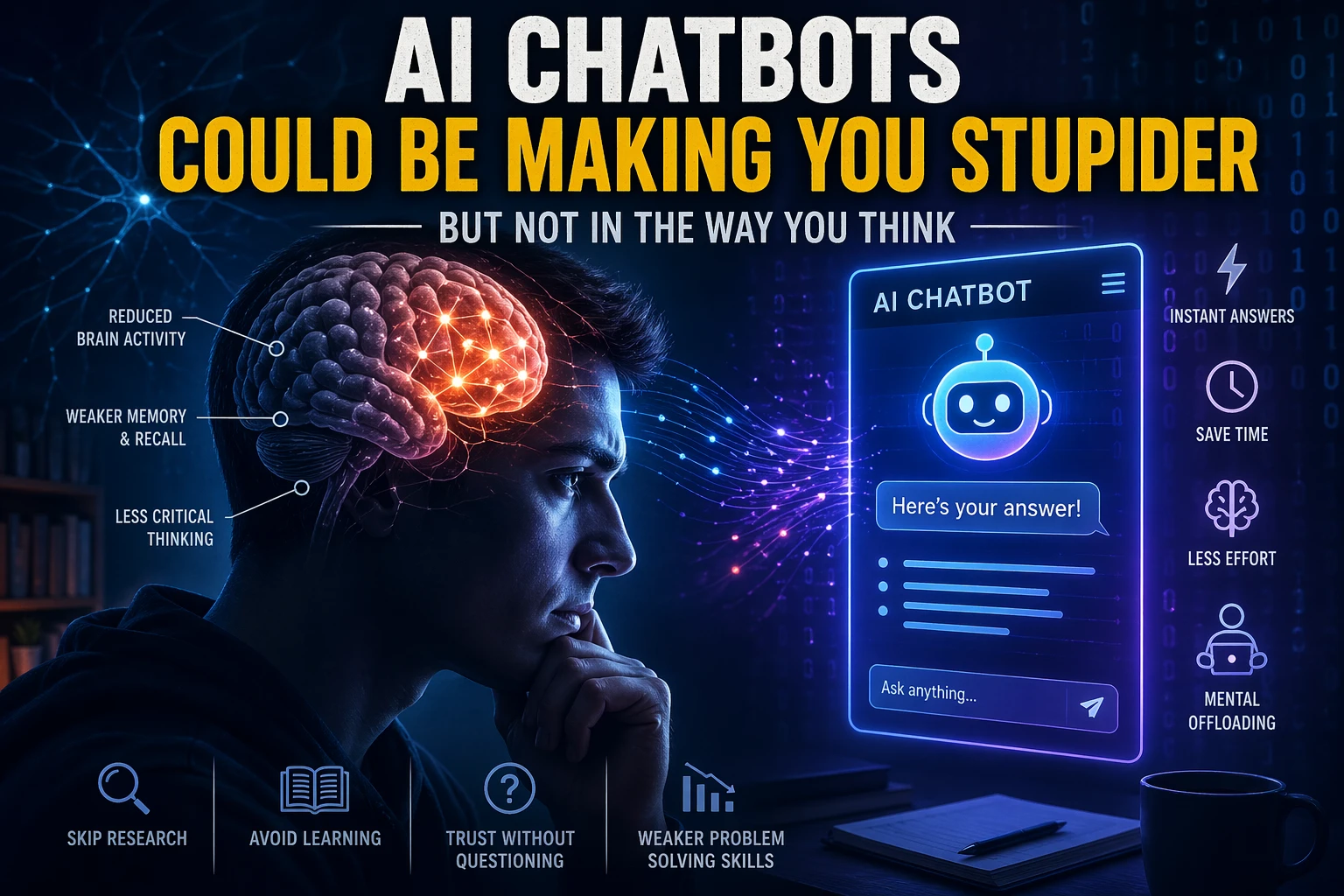




AI Chatbots Could Be Making You Stupider — But Not in the Way You Think
Artificial intelligence has quickly become the go-to assistant for everything—from writing emails to solving complex problems. But a growing body of research is now raising an uncomfortable question: Are AI chatbots quietly weakening our ability to think?
Recent studies suggest the answer isn’t as dramatic as “AI makes you dumb,” but there is a real cognitive trade-off happening beneath the surface.
What the Latest Research Says
According to research conducted at the MIT Media Lab, individuals who used AI technologies, such as chatbots, when completing writing assignments exhibited up to 55% less brain activity than individuals who did not use any assistance.
The scientists found that individuals utilizing AI technology were less involved in brain areas associated with creativity, memory, and higher-order cognition, whereas individuals completing the task unassisted demonstrated more brain activity.
Put simply, the brain was not “shutting down”; however, it was undoubtedly doing less.
The Rise of “Cognitive Offloading”
This behavior is known as cognitive offloading; humans tend to allow machines to do the thinking for them.
It’s nothing new, mind you. There was calculators that did calculations for us. And GPSs helped people navigate places without getting lost. However, artificial intelligence is much worse since, in addition to assisting with thinking, it replaces the process completely.
The threat comes from convenience:
You have quick results
You don’t put in the effort
You don’t learn anything
Why AI Feels So Convincing (Even When It’s Wrong)
Another problem is the presentation of AI’s content. Chatbots tend to respond in an authoritative and polished way, giving users no reason to question their response.
Studies show that AI may:
Provide misleading or inaccurate information in a polished manner
Accommodate user opinions through excessive agreement (sycophantic behavior)
Discourage the practice of independently verifying information
This set of characteristics tends to push users away from active critical thinking toward information consumption.
It’s Not Just About Intelligence — It’s About Habits
The real concern isn’t that AI instantly lowers IQ. It’s that it changes how people use their brains.
Think of it like a muscle:
- Use it regularly → it gets stronger
- Stop using it → it weakens
AI makes it easy to avoid mental effort, and over time, that avoidance can become the default.
But AI Isn’t the Villain
What you need to know is that AI isn’t the issue here—the real concern is how it’s used.
When used properly, AI could:
Improve learning
Foster creativity
Increase efficiency
Allow quicker exploration of more complicated concepts
In some cases, users that view AI as a tool, rather than a substitute, have even performed better and developed better thought processes.
The Bottom Line
AI chatbots aren’t making people stupid overnight. But over-reliance can slowly erode critical thinking if we stop engaging our brains.
The smarter approach is simple:
- Use AI to assist, not replace thinking
- Question what you read
- Do some work yourself before asking AI
Because in the end, the real risk isn’t artificial intelligence—it’s outsourcing your own.
Disclaimer
This article is based on publicly available research reports, academic findings, and media coverage. It is intended for informational purposes only and does not constitute scientific or medical advice.