





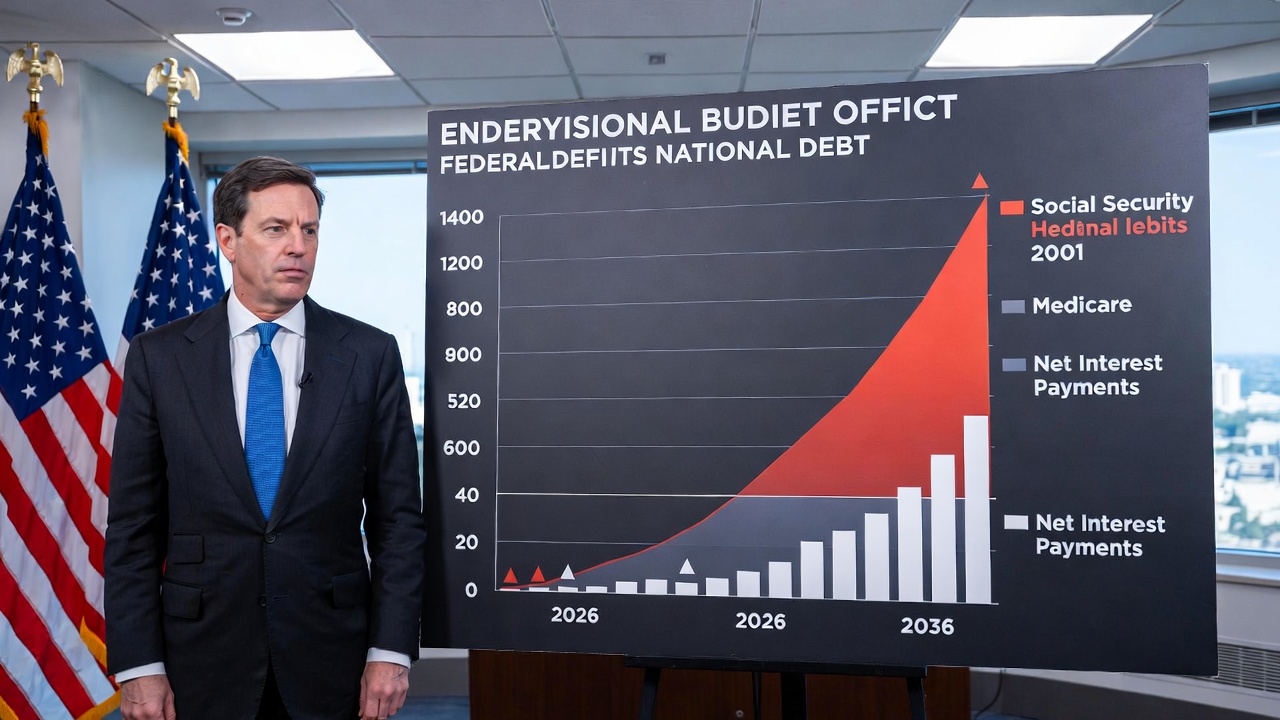
The Congressional Budget Office (CBO) projects US federal deficits averaging 6.1% of GDP over the next decade, rising to $3.1 trillion by 2036. Public debt is expected to climb from 101% to 120% of GDP, driven by Social Security, Medicare, and interest costs. Latest 2026 outlook details the worsening fiscal trajectory.
The Congressional Budget Office (CBO), in its Budget and Economic Outlook for the years 2026-2036, published on February 11, draws a dismal scenario for the financial prospects of the United States. According to the CBO report based on current laws, the budget deficits will remain large and surge even higher in the coming years, leading to an unprecedented rise in the public debt.
According to the agency, “the federal government’s budget deficit for its current fiscal year, 2026, totals $1.9 trillion, or 5.8% of GDP, much in line with its level in 2025. But these will continue to grow steadily, topping $2 trillion in 2028, and $3.1 trillion, or 6.7% of GDP, as far out as 2036. Over the ten-year period from 2026 to 2036, its cumulative total will be $24 trillion to $25 trillion, or an average of 6.1% of GDP each year, more than twice its average over the past half-century of 3.8%.”
Federal debt held by the public, currently hovering near 99-100% of GDP, is projected to rise to 101% by the end of 2026, surpass its post-World War II record of 106% by 2030, and climb to 120% of GDP by 2036. This trajectory marks a significant deterioration from prior baselines, with deficits over 2026-2035 now estimated $1.4 trillion higher than in CBO’s January 2025 projections.
Key Drivers Behind the Worsening Outlook
- Spending growth that is mandatory-particularly in Social Security and Medicare-largely reflects an aging population and rising health care costs.
- Net interest payments on the debt: These are forecast to swell from roughly $1 trillion (3.3% of GDP) in 2026 to $2.1 trillion (4.6% of GDP) by 2036, becoming one of the largest items in the budget and crowding out other priorities.
- Policy factors – Changes such as the 2025 reconciliation act (more commonly referred to as the One Big Beautiful Bill Act or OBBBA), which will reportedly add trillions of dollars to deficits via tax cuts as well as various spending provisions. However, the effects are partially mitigated via tariffs (adding up to $3 trillion in savings). Immigration policy changes are noted as factors for the deceleration of labor force as well as potential output.
In addition, although the 2025 reconciliation act provides a short-run boost to economic activity, with growth over 2 percent in real GDP in 2026 projected at 2.2 percent, growth begins to slow again, to 1.8 percent annually from that level. Tariffs, while creating headwinds on consumption and investment, do support more revenue.
Economic Context and Implications
Inflation is envisaged to be within the Federal Reserve’s target of 2% by the year 2030; however, interest rates will be higher compared to before the pandemic. More debt is likely to lead to further increases in interest rates, leading to a cycle of deficits.
Experts and analysts alike have termed these projections to be “stark warnings.” Experts at The Committee for a Responsible Federal Budget have specifically emphasized, “Such deficits are unprecedented for a growing, peacetime economy,” while also emphasizing the need for bipartisan action on mandatory spending, revenues, and overall fiscal sustainability. The interest expenses, growing by themselves, could consume increasingly large percentages of federal revenues, reaching 26 percent by 2036.
Looking forward
The CBO baseline assumes current laws remain unchanged, precluding the possibility of new legislation, economic shocks, or policy changes. However, this report really captures the importance of addressing structural imbalances before debt dynamics become more binding.
With the newest CBO outlook, policymakers debate spending priorities, tax reforms, and entitlement adjustments that will be weighing options in the coming years. Stabilizing the debt trajectory will require difficult choices on both the revenue and expenditure sides to avert long-term economic risks.