







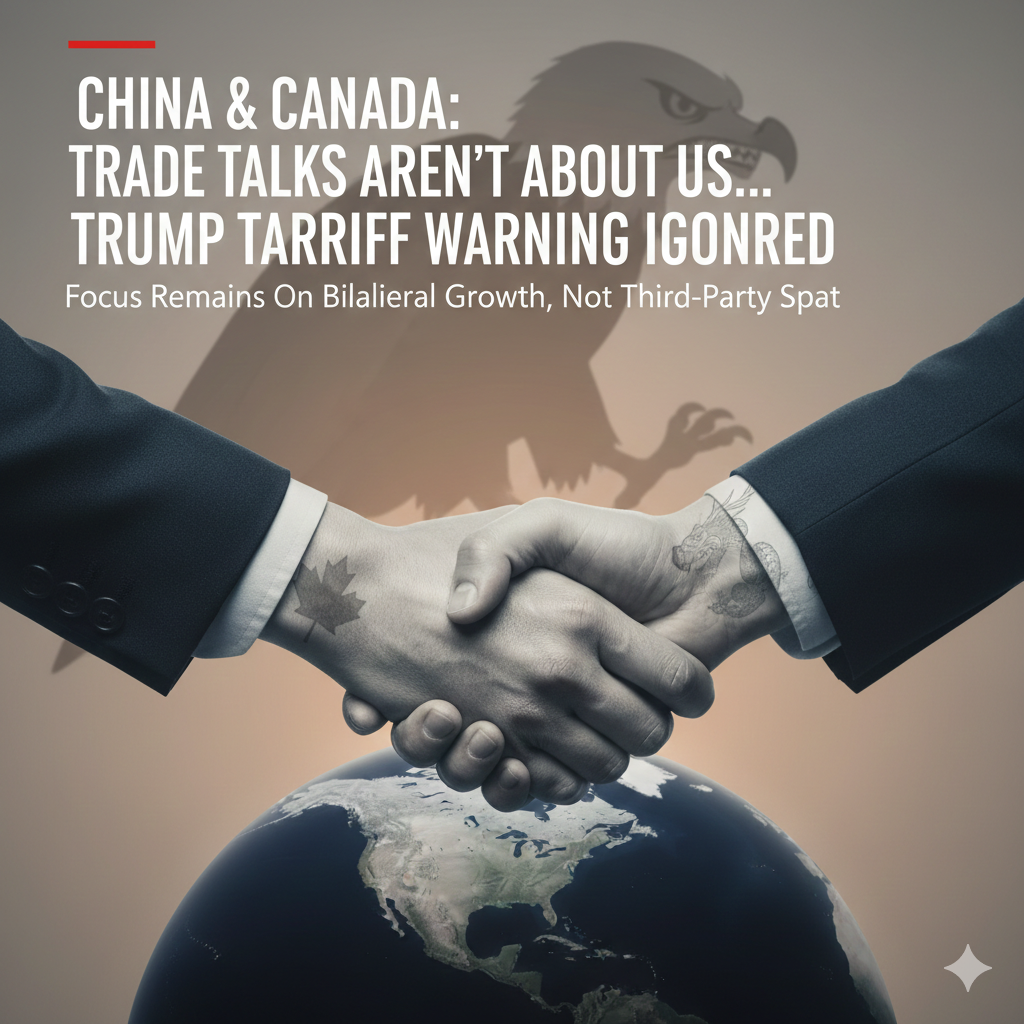
China on Tuesday denied that its recent trade agreement with Canada is targeted at the United States, rejecting claims that the agreement was a response to possible tariffs imposed by former US President Donald Trump.
The denial comes after Trump threatened that if he is re-elected, he will impose tariffs on imports from countries he believes are practicing unfair trade practices, including China. The statement has reignited global trade tensions and fears of the future of global trade rules.
During a regular press briefing, a spokesperson for China’s foreign ministry said that the cooperation between China and Canada is “based on mutual benefit and normal economic exchanges” and should not be interpreted as targeting any third country.
“China’s trade and economic cooperation with Canada is based on market principles and international trade rules,” the spokesperson said. “It is not targeted at the United States or any other country.”
China and Canada have recently conducted talks to enhance their economic engagement, including cooperation in agriculture, clean energy, and supply chains. Although the specifics of the talks are not available, experts believe that the engagement is part of Beijing’s efforts to stabilize trade relationships with major partners in the face of rising uncertainty over US trade policies.
Trump’s latest tariff threats have disturbed global markets, with investors being cautious about the possibility of a return to aggressive protectionist policies, which could disrupt supply chains and slow down global growth. During his tenure as president, Trump imposed tariffs on Chinese goods worth hundreds of billions of dollars, leading to a trade war between the world’s two largest economies.
Canada, another major US ally, has also had trade tensions with Washington in the past, including trade disputes over steel, aluminum, and dairy exports. Nevertheless, Chinese officials emphasized that the talks between Ottawa and Beijing should be considered in the context of US politics.
Analysts believe that China is probably trying to diversify its trade relationships as geopolitical tensions escalate. Meanwhile, Canada is trying to strike a balance between its economic and strategic relationships with the United States.
As the US presidential election campaign heats up, uncertainty over US trade policies is expected to remain a major concern for markets around the world.